


Construction Engineering Firm Identifies $6.9M in Potential Cost Savings by Rebalancing Employee Time

Context
After years of steady growth driven by new clients, geographic expansion, and acquisitions, the firm began to experience growing pains. Communication issues across business units and uneven allocation of resources meant that consultants were spending less time on billable, client-facing work. At the same time, additional administrative roles had been added, but without a corresponding lift in overall productivity. Leadership recognized that they needed better clarity on how people were spending their time and how to realign effort toward revenue-generating activities.
What We Discovered
Working closely with leadership and employees, the team set out to understand the firm’s ideal distribution of time and what was preventing it. The discovery approach included one-on-one interviews and a company-wide survey designed in partnership with a cross-functional working committee. This process surfaced several key gaps:
- Unclear roles and responsibilities across Strategic Business Units (SBUs), leading to overlap, confusion, and unnecessary handoffs.
- Inconsistent and underutilized training programs, including legacy training that had previously supported more efficient ways of working.
- Limited visibility for managers into how employees spent their time, their skillsets, interests, and project assignments, making it difficult to deploy people effectively.
These issues drove up indirect time, reduced focus on client work, and contributed to higher-than-necessary overhead costs.
Results and Impact
Within an 8-week engagement, the client realized immediate clarity and actionable opportunities:
- Company-wide agreement on indirect time targets at each role level, supporting an increase in time spent on client projects by 4.5% and contributing toward a 75% improvement goal in revenue-generating time.
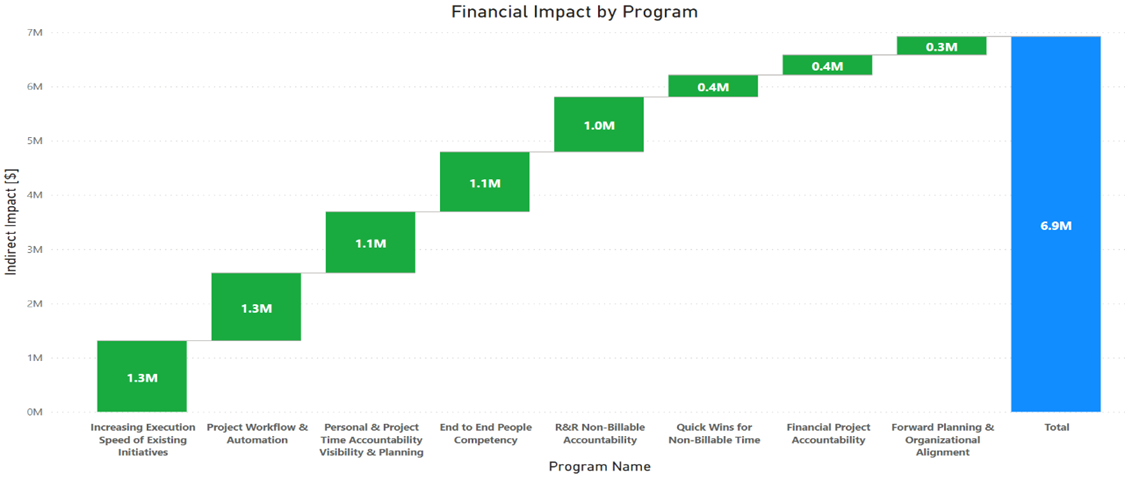
- $6.9M in potential indirect cost savings over the next 18 months, identified by leveraging past initiatives and defining new strategic, firm-wide actions.
- Improved managerial visibility into employees’ skills, responsibilities, development interests, and project assignments, enabling smarter staffing and more intentional use of employee hours.
Collectively, these changes positioned the construction engineering firm to redirect more effort toward billable work, reduce unnecessary overhead, and capture significant cost savings while supporting employee development and clearer accountability.
What We Did
- Clarified roles and responsibilities
- Defined clear responsibilities and accountabilities for employees and leadership within each SBU.
- Reduced ambiguity about who owns which tasks and decisions, helping to limit unnecessary administrative work.
- Strengthened and standardized training
- Reviewed legacy training programs and identified those that could be standardized and reintroduced.
- Created a more consistent, structured training approach to support efficiency and capability-building.
- Enhanced visibility into employee time and capabilities
- Designed a dynamic view of employee time allocation, skills, development interests, and current staffing.
- Enabled managers to make more informed resourcing decisions and better match people to revenue-generating work.